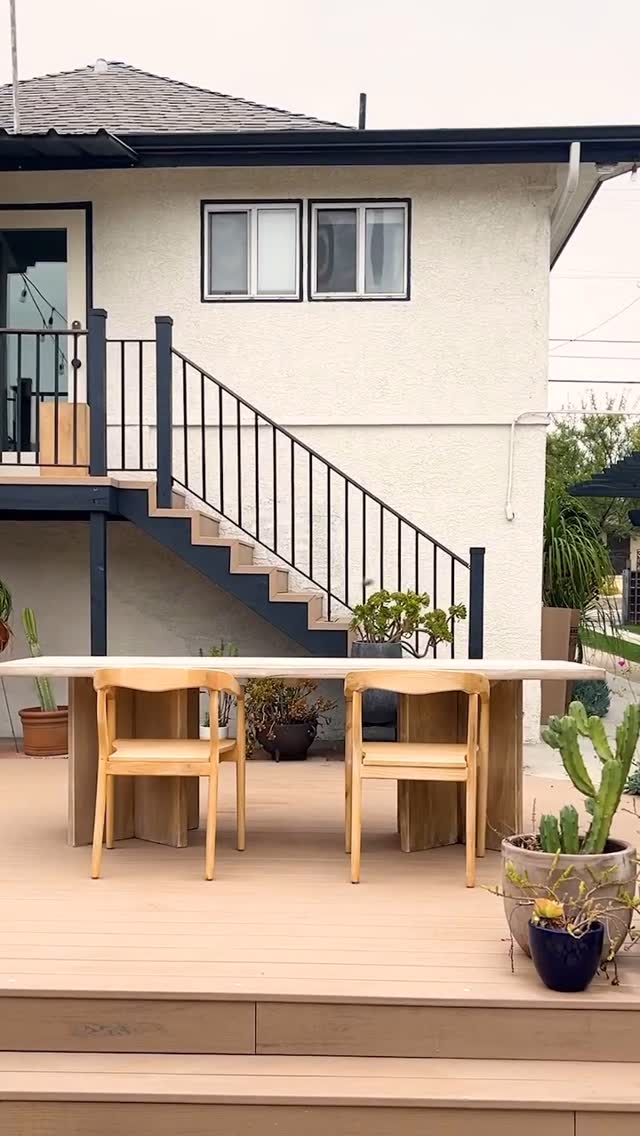
Not every backyard needs a raised deck. Step out of most patio doors in Simcoe County and you are one step from grade, which opens a cheaper, simpler set of options: a stone patio, a concrete pad, or a low platform deck. All three give you the same thing in June — a flat, clean place for the table, the grill, and the people. They part company on what happens underneath, in winter, over five years of freeze and thaw in our soil. Here is the comparison I give at kitchen tables, the same one I would want if it were my yard and my money.
Stone patio (interlocking pavers or natural stone)
How it is built, properly: excavate six to eight inches, compact, a base of crushed stone compacted in lifts, a bedding layer, the stone, and polymeric sand swept into the joints. The base is the patio — the stone is just the part you see.
- Drainage: excellent when graded right. The joints let a little water through and the whole surface is pitched away from the house, about a quarter inch per foot minimum. A patio can also be shaped — swales, curves, a dry well at the low corner — in ways a pad cannot.
- Heaving: the honest weakness. Individual stones can lift and settle with frost, especially on the clay patches Simcoe County is full of. The defence is the base: deep, compacted, and edged. A lifted stone is also the easiest repair on this page — lift it, re-level the bedding, set it back.
- Year five: joints may need fresh polymeric sand once, weeds will test any gap you leave, and a well-based patio looks essentially new. A cheap-based patio looks like a quilt by year three.
- Maintenance: the lowest of the three that still counts as a structure. No staining, no sealing schedule unless you want the wet look.
Concrete pad
How it is built, properly: excavate, compact, gravel base, forms, mesh or rebar, control joints cut or tooled at proper spacing — and in this climate, air-entrained concrete, because plain concrete surfaces scale and flake under freeze-thaw and road salt tracked off the driveway.
- Drainage: a pad is a roof lying on the ground — everything runs off it. Pitch it wrong and it delivers your whole yard's water to your foundation in a sheet. Pitch it right and it is the cleanest surface of the three.
- Heaving: concrete does not forgive. A pad that heaves at a joint cracks, and a crack is forever — you can seal it, you cannot un-crack it. The base and the joints are the whole game: joints give the slab planned places to move so it does not choose its own.
- Year five: a good pad looks like a good pad, with honest hairlines at the joints. A bad pad — thin, un-reinforced, poured on un-compacted fill by the lowest bidder — is spalling, settled at the corners, and priced into a jackhammer for its removal.
- Maintenance: nearly none, beyond keeping salt-heavy ice melters off it in its first winters.
Low platform deck
How it is built, properly: a deck that happens to be low — which means it still deserves footings or proper deck blocks on prepared pads, framing off the ground on posts or beams, and airflow underneath. "Low" is where people are tempted to lay framing nearly on the soil. Do not. Wood near grade, without ventilation, in our climate, is a rot farm with a five-to-eight-year fuse.
- Drainage: the surface sheds water between the boards, so what matters is the ground underneath — it must be graded to move water out from under the structure, with landscape fabric and gravel to keep the mud and the weeds down.
- Heaving: a deck on proper footings below the frost line does not heave, full stop — it is the only one of the three that can say that. A deck on surface blocks alone will move like a patio, and a moving deck racks its own fasteners.
- Year five: pressure-treated boards will want stain or sealer on a two-to-three-year rhythm and will grey if they do not get it. Composite boards will want a wash. Underneath is where the year-five story is written: ventilated and dry, the framing is like new; trapped and damp, it is already ageing.
- Maintenance: the highest of the three — it is the trade for a surface that is warm underfoot, kind to dropped glasses, and level even where the yard is not.
The short version
Choose the stone patio for the best five-year looks per dollar and the easiest repairs, on any yard you can grade. Choose the concrete pad for a hard, flat, zero-maintenance surface where the base will be done properly and the pitch is simple. Choose the low deck when the yard slopes, the soil stays wet, or you want the feel of wood — and build its structure like a real deck, because the frost does not grade on a curve for short projects.
All three are in our wheelhouse, and the right answer depends on your grade, your soil, and how you actually use the space. Book a free estimate at calendly.com/conceptsinc/construction-estimate-service or call (705) 330-2911 — we will walk the yard, poke at the slope and the soil, and tell you plainly which of the three your backyard is asking for.