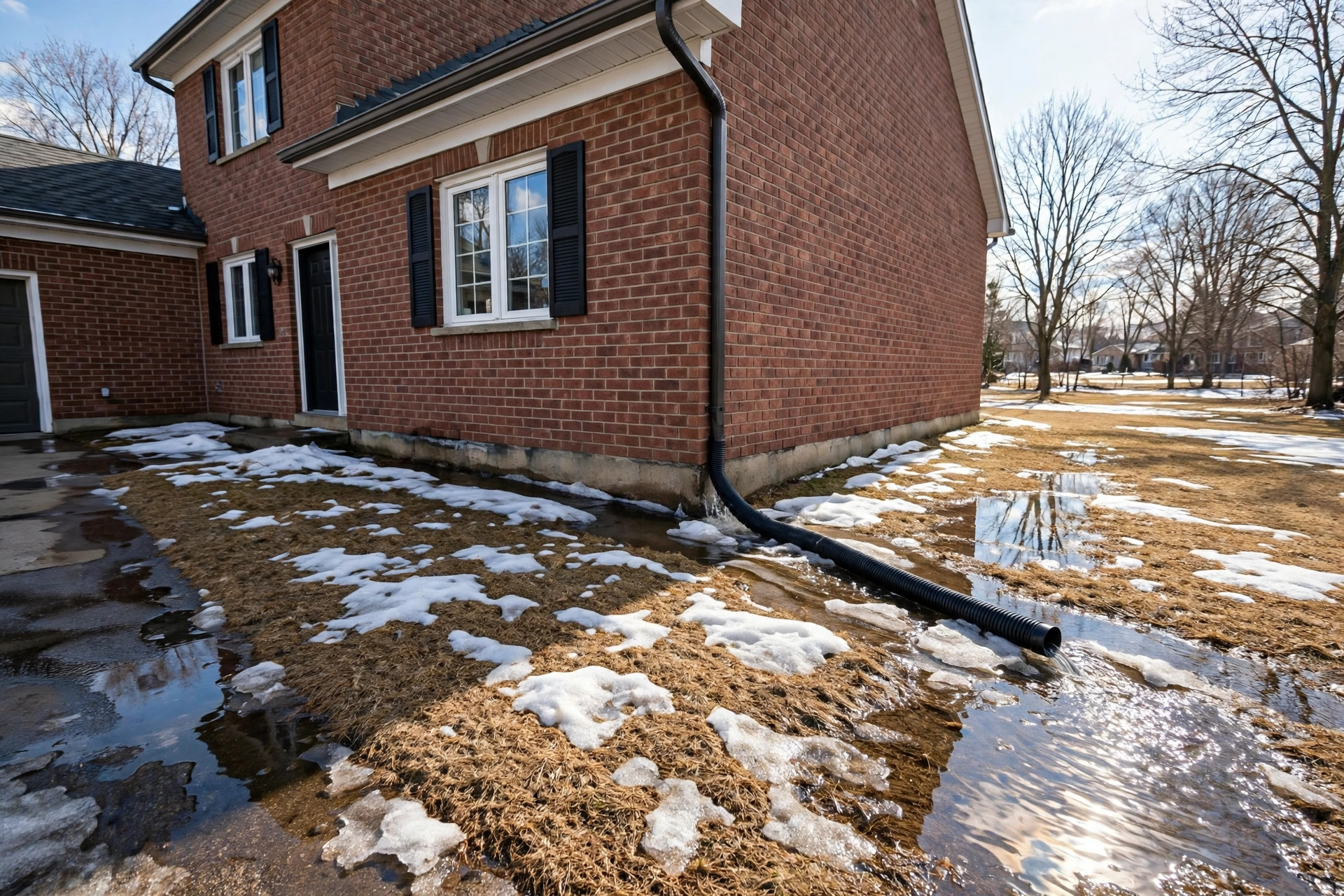
Every March there is a week — sometimes only three or four days — when winter lets go all at once. The snowpack in a Simcoe County yard holds an enormous amount of water, and when a warm spell with rain arrives on top of it, that water has to go somewhere. The ground underneath is still frozen solid a few inches down, so it cannot soak in the way it would in June. It runs. And where it runs is along the surface, downhill, toward the lowest thing in its path — which is very often your foundation.
I get more water calls in thaw week than in any other week of the year. The good news is that melt water is predictable. It does not test your whole house at random. It tests the same handful of spots, in roughly the same order, every single year.
The hour it matters
Melt runs on a daily cycle. Overnight, when the temperature drops back below freezing, the flow slows to almost nothing. By mid-afternoon, after the sun has worked on the snowpack for hours, the flow peaks. On a bad thaw day the peak runs from about 2 p.m. to early evening.
That is the hour to be watching. If you are going to see water at a basement wall, over a window well, or backing up at a floor drain, you will most likely see it in that window. A basement that is dry at 9 a.m. tells you almost nothing in thaw week. A basement that is dry at 5 p.m., at peak melt, is a house that is coping.
The three places it gets in first
At the foundation, where the grade has settled. Over the years the soil along a foundation wall settles and slopes toward the house instead of away from it. In summer rain that might not matter. In thaw week, a river of melt runs along the wall and sits against it for hours, and water under even a little pressure finds the tie holes, the cracks, and the joint where the wall meets the footing. Walk your foundation at peak melt and look for the stretches where water is ponding against the wall instead of running past it. Those are your summer grading fixes, written down for free.
The window wells. A below-grade window well is a bucket sunk beside your foundation, and in thaw week it fills from the top — with melt running off the wall and the yard — faster than the gravel at the bottom can drain it, especially when that gravel is still frozen. Once the water in the well is higher than the bottom of the window, it comes in under the sash. Check the wells during the peak. If one is filling, clear the snow out of it and give the water somewhere to go. A well cover helps, but a well that fills from surface runoff needs the grade fixed, not just a lid.
The downspout dumping at the wall. One downspout can move the melt off half a roof. If that downspout ends at the foundation — and on older homes, half of them do — it is delivering thousands of litres directly to the worst possible spot, all week long. Extensions are cheap and ugly and they work: get the discharge at least six feet from the wall, sloping away. In thaw week I would rather see a homeowner with a $15 extension from the hardware store than a homeowner with a finished basement and a downspout ending at the footing.
What to do while it is running
- Move stored belongings off the basement floor and away from any wall that has shown damp before. Cardboard on concrete wicks water and hides it.
- Clear the snow away from the foundation on the uphill side of the house, even a couple of feet. You are building the melt a different path.
- Know where your floor drain is and make sure nothing is stored on top of it. If water does come, you want it to have somewhere to go.
- Take photos of any water you find, with the time. If the same spot shows up every spring, that pattern is exactly what we need to see to fix it properly.
What a thaw-week leak is telling you
A dry basement in a dry week proves nothing. Thaw week is the honest test, and a house that takes water in March is telling you where it will take water in the next big summer storm — the same wall, the same well, the same downspout. The fixes are mostly unglamorous: regrading, downspout extensions, well drainage, and where the foundation itself is cracked, proper structural repairs done from the right side of the wall.
If your basement took water this thaw, or you watched it pond against the wall and got away with it, that is worth a look before the spring rains. Book a free estimate at calendly.com/conceptsinc/construction-estimate-service or call us at (705) 330-2911 — we will walk the foundation with you and tell you plainly what needs doing and what can wait.