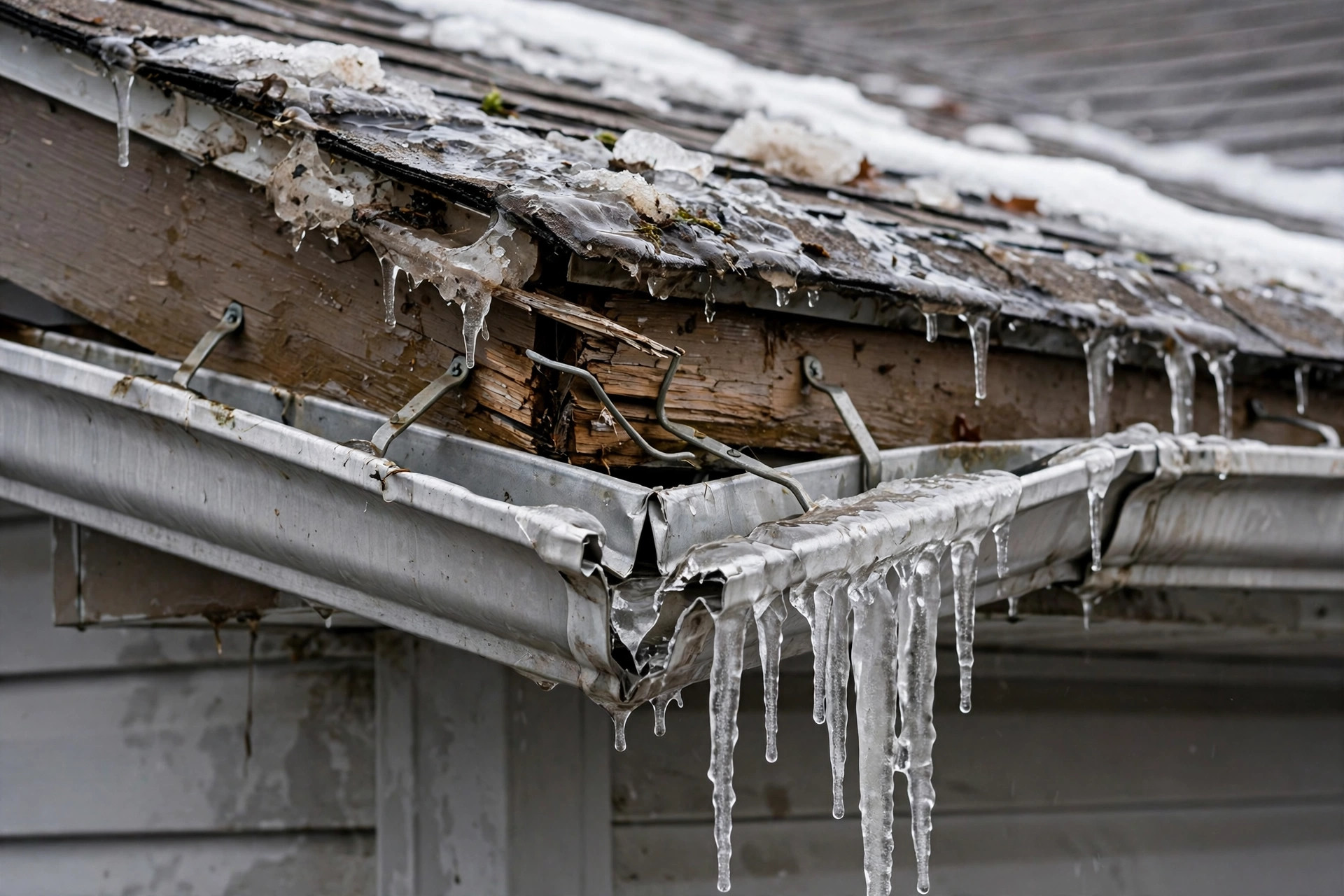
An eavestrough full of ice is a heavy thing. Water weighs about a kilogram a litre, and a long run of trough packed with ice and frozen slush can hang several hundred kilograms off your fascia board all winter. The trough was never designed to carry that — it was designed to carry water that is moving. So every spring, the same failures show up, and most of them are visible from the ground with a coffee in your hand.
Do this walk in March, before the spring rains arrive to test the system at full flow. Here is what to look for, and what each thing means.
Overflow stains on the siding
Look at the siding and the foundation directly below the trough line. Dark streaks running down the wall, green algae staining, or a trench worn into the soil and mulch below the eave all say the same thing: water is going OVER the trough instead of down the downspout. In winter that is usually ice — the trough filled, froze, and every melt after that sheeted over the top and down your wall.
Overflow is the symptom, not the disease. The causes are a trough that has lost its slope, a downspout plugged with ice or debris, or a run that was undersized for the roof area feeding it. Left alone, that overflow is not a cosmetic problem: it is water delivered against your foundation and into your soffit, season after season. It is also how a share of the roof damage calls I get in spring actually started.
Seams split open
Sectional eavestroughs are joined at seams, and ice is patient at seams. Water gets into the joint, freezes, expands, and wedges it a fraction wider. Repeat that thirty times in a winter and the sealant lets go. From the ground, look for drips at the joins on a rainy day, icicle rows that formed at one specific joint all winter, or a visible gap and daylight at a corner.
A split seam on an otherwise sound trough is a repair: clean it, re-seal it with proper gutter sealant — not household caulk, which gives up in a season — and check the slope while you are up there. A trough with seams failing everywhere is telling you its age, and resealing ten joints on a trough that is also rusting or sagging is money spent twice.
Pulled spikes and a sagging line
Stand back and sight along the trough. It should run straight with a slight, even fall toward the downspout. After a hard winter you will often see a belly — a section that sags between its hangers. That is the ice load pulling the spikes or screws partway out of the fascia.
A sagging run holds water instead of draining it. Standing water means more ice next winter, which means a heavier load, which means more sag. It feeds itself. The fix is to re-hang the run with proper hidden hangers screwed into the fascia — screws, not the old spike-and-ferrule nails that work loose — and re-establish the slope, roughly a quarter inch of fall for every ten feet of run. If the fascia board behind it has rotted from years of overflow, that gets dealt with first; hangers in rotten wood are decorations.
Ice-split corners and cracked end caps
Corners take the worst of it because water turns there and slows down. Look for corners that have opened up, end caps pushed out, and downspout elbows split along the seam. A downspout that froze solid can split its back seam from top to bottom — from the front of the house it looks perfectly fine, and it leaks like a sieve against your foundation every rain.
Repair or replace: the honest call
Here is how I make the call on the ladder:
- Repair it when the trough itself is sound — no rust-through, no widespread cracking — and the damage is local: a seam or two, one sagging run, a split elbow. Most post-winter troughs are this.
- Replace it when you count failures in every section, the trough is rusted or brittle, or the slope problem is the whole system. Seamless trough, run off on site to the exact length of your eave, removes most of the joints that winter attacks in the first place.
Either way, do it before the spring rains do the inspection for you — they will find every weakness on this list in a single storm, and the water will land against your foundation while they do it.
If your walk turned up more than you want to deal with from a ladder, we are happy to take the same look and tell you which of it is repair and which of it is replace. Book a free estimate at calendly.com/conceptsinc/construction-estimate-service or call (705) 330-2911.